Tuesday, 10 July 2012

Hey look, a marine iguana!

Day 4 - Isabella Island; Targus Cove, Fernandina Island; Punta Espinoza

We woke in the crater of an old volcano.  The seaward wall has collapsed and the ocean has flooded in. By 6:30 we started climbing the trail that led past another crater, Darwin Crater,  slightly above sea level, but full of seawater nonetheless, thanks to filtration through the basalt.

Darwin crater in the foreground, Fernandina Island on the horizon


At the top of the hike, Wolf crater in the background


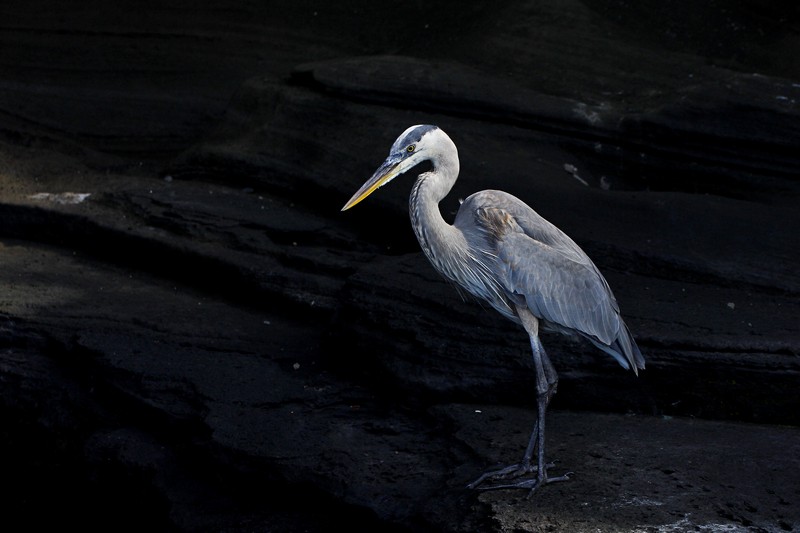
A panga ride along the edge of  the crater cliffs revealed penguins, flightless cormorants, bluefooted boobies, a blue grey heron, marine iguanas, sealions.  With the motor puttering quietly, the gentle plash of the bow wave and the smooth slide of the sea it was divine.


Then it was time to get in the water for a snorkel.  The marine life was more abundant here, with some brightly coloured fish and more sea turtles eating the algae.  Flitting through quickly, difficult to spot, were the fishing penguins.  

The highlight was a flightless cormorant fishing underwater, holding his breath for two minutes and chasing little fish under the rocks.  He bobbed right up next to us, close enough to touch.

The flightless cormorants look a little unlikely on land, but underwater they are in their element, swimming so fast with their webbed feet.


The afternoon was spent in fascinated delight on Fernandina Island.  There is nothing quite like going for a walk and having to be careful not to step on the wildlife.  Marine iguanas were feeding on algae in the shallow rocks, then would swim to shore and lie on the hot rocks to warm up again.

Marine iguanas are pretty slow moving on land and tend to lie almost completely motionless.   Every so often they will spit violently; actually they are clearing the salt build up from their nose!  Ben loved taking photos of them as they are very obliging (ie don't care how close you get) and the whole dinosaur look of them.  I wasn't so keen on them until now, when we could see them feeding on the algae underwater and swimming with their tails


Accompanying them were sea turtles, sealions, the odd heron, a hawk in the distance and many Sally Lightfoot crabs. We discovered that the crabs can really jump; we spent quite a while watching them line up to jump the gap below:


The sealions are gorgeous, sleek and liquid eyed.  The calves wait in the shallows whilst mum fishes, calling occassionally in case she has returned without letting them know.  The back flippers are separated, unlike seals, so they can move around on land surprisingly well.


A fur sealion


Back to the Nemo, through a horde of marine iguanas, to set sail immediately, in the vain hope that dolphins or whales will be spotted and to cross the equator twice in the night.


Saturday, 7 July 2012

Old land, new land

Day 3 - Isabella Island; Punta Moreno, Urbina Bay

Clink, scrunch, crunch - the sound of walking across basaltic lava.  The landing at Punta Moreno on Isabella Island was on a lava field approximately nine million years old. The lava field was extraordinarily sharp and starkly barren in places.  But life is starting to colonise it; not just in the lagoons formed by lava bubbles collapsing and filling with filtered water from the highlands, but also in the cracks and fissures in the lava itself.


To my delight one of the larger lagoons contained three flamingos. They were a little distant for good photography, but lovely to look at.  The lagoons closer to the sea sometimes have seawater in them as small lava tubes go down to the water.  Small fish and shrimp travel up them, then get stuck in the lagoons.

The walk ended at a little inlet with a sweet little beach  on the opposite side containing two sealions.  One promptly got in the water and swam up and down the channel to see us better. Then we could see sea turtles and a penguin.  Fabricio said we could swim if we wanted to before the panga came to pick us up.  I leapt at this offer;  while the shore had a nice breeze the interior had been pretty hot on the basalt.

I managed to get up close to a penguin and had just spotted a sea turtle when I was recalled to the rocks to wiggle into my wetsuit with everyone else.  The water around the Galapagos is cold at this time of year due to the Humbolt current - though 18C is hardly freezing.  The panga dropped us across the bay where we spent a magical hour snorkeling, watching turtles drift through the water, graze on rocks and be cleaned by helpful fish.

There were lots of different kinds of fish, some with lovely colours and stripes, but not really the tropical display found in other places.  One sealion eyed Ben and I from a distance, but didn't come any closer.  No sharks put in an appearance.

Back on board for another delicious lunch, then two hours of motoring two our next landing spot, Urbina Bay.  This is a very new piece of land, pushed out of the sea less than 60 years ago.  Here we disembarked on a little beach that has sea turtle nests above the high tide line.  We saw three giant tortoises, many land iguanas, cactus finches and ground fiches.  Plus lots of large hermit crabs who did their best to pretend to be innocent shells.

Heading into Urbina Bay


Ben and a land iguana


Land iguana up close


Another lava lizard


Galapagos grasshopper:


Two Galapagos Grasshopers . . .


The problems of a telephoto lense and wildlife that is so incredibly close; you can't always get far enough away to get everything in the shot.


Darwin finch


Everyone liked the hermit crabs.  I particularly liked how their legs fit so well together when they draw them up to go into the shell.


Female giant tortoise, slightly smaller than the males


As we waited for the panga to come and pick us up we watched a penguin fishing in the bay.  It was easy to track his progress as showers of little silvery fish would scatter out of the water and through the air to get away.  He came in very close to the beach, not at all worried by his audience.

The large Sally Lightfoot crabs in the rocks were less obliging for Ben to take photos - clearly no-one has told them that they are protected here - they scuttled away very quickly.

There was a glorious sunset as the catamaran headed west, before dropping anchor for the night at the next landing site.


Friday, 6 July 2012

Giant Tortoises in the grass

Day 2 - Santa Cruz Highlands, Charles Darwin Center


A very cruisy day, off to the highlands in an organised bus to see the giant tortoises in ´the wild´. It was actually on private land that happens to be where the tortoises hang out. It was a little strange seeing them in lush grass. The tortoises are named after ´Galapago,´ an old Spanish word for saddle.


Time for a quick wander in Puerto Ayora before back to the boat for lunch. Then back to shore to visit the Darwin Centre. This was a slightly sad visit as Lonesome George, the 120 year old tortoise from Pinta Island and the last of his subspecies, had died. 

The centre collects tortoise eggs and hatches them, keeps the young until they are five to six years old, then releases them back into the wild. Each island has a different subspecies of tortoise, so they are kept separate to ensure there is no interbreeding. There is even an enclosure with seven male tortoise's that were sent homes from zoos around the world; they are not allowed to breed as they are mixed. 

We didn´t leave the harbour until 9:30 as Fabricio had been called to the press conference about Lonesome George´s death. He has been guiding for more than 30 years and his licence number is 002. There was concern on the boat as we´d been warned that the passage would be rough, but we were all safely tucked up in bed, full of seasickness medication by the time we left the harbour. It was quite bumpy and rocky at times, so sleep was a little broken, but no-one got sick.

One of the many Darwin's finches


Another lava lizard, one of the seven different species


Nemo II in the harbour (the catamaran in the centre of the picture)

Thursday, 5 July 2012

Setting sail

Day 1 - Baltra pick-up, Daphne Major, North Seymour

We had to travel back across Santa Cruz Island, cross the channel to Baltra, then back on the bus to the airport to meet our guide.  The airport was slightly chaotic but eventually we found Fabricio and the rest of the group.  Then back on another bus and down to a little harbour where there was no sign of the Nemo II . . . 

After half an hour she motored into harbour, we transfered over and had our briefing whilst the crew loaded all the supplies; boxes and crates and chillers and fruit and vegetables.

Finally we were  underway, to circle around Daphne Major, the island Ben had taken a photo of from the plane.  This is the top of a volcano and is famous for the work of two scientists on the finch population evolution.  Fabricio told us how the scientists are a couple who spend 8mths of every year there, living in a tent, and have been doing it for over 40 years.  All I could think was that it could be a sure recipe for divorce!  We saw sealions, nazca boobies, frigate birds and tropic birds.

The first landing was on North Seymour,  a low lying island north of Baltra.  As we climbed into the panga  (the name for the inflatable tender)  we were filled with anticipation and excitement.  As the rocky landing grew closer sealions swum under the panga, crabs skittered round the rocks and seabirds soared overhead.

As our first proper introduction to Galapagos it was fantastic: wildlife everywhere and totally unconcerned with us.


There were blue-footed boobies everywhere; doing the boobie courtship dance and sitting on their nests. The boobies are a favourite of visitors and it's easy to see why; the dance is carried out in slow motion and does look quite hilarious. From the side the birds look quite intelligent, but when they look at you directly they look  a little daft.


Frigate birds are very common throughout the islands, huge soaring seabirds with a wickedly hooked beak.  They are a little unusual as they don't have oil in their feathers, so they can only fish food from the surface of the sea.  The males have an extraordinary mating acoutrement - a large red throat sack.  On North Seymour we saw them in all life stages; nesting, juveniles, males with deflated pouches and one in all his displaying glory.


There were more marine iguanas for Ben to take even more photos of, plus different kinds of lava lizards.


The other large reptile is the land iguana.  These were imposingly stationed throught the brush; much larger, more colourful and even more dinosaur like than their marine cousins.


As we slowly meandered back to the panga, our senses overloaded, our camera cards brimming, our landing was completed with sealions cubs.  Fabricio imitated an adult's call, so they duly came over to us, hoping that we would have some food as they wait on the beach or rocks while their mothers fish.  Up close they were even cuter.  Apparently 60% of all photos taken in the Galapagos are of sealions . . .  though I think Ben had more marine iguanas.

Even though we had been told about how the wildlife was so unconcerned with people in their midst it was still wonderful and delightful to be so close.


That night in the saloon, as we were motoring through the waves, Fabricio reviewed the day and the briefed us for the next day.  This wasn´t the best strategy as by dinner we were down to only half the passengers . .  . there were some seriously sick people, though I have had to promise not to name names.  Luckily Ben and I had stocked up on seasickness medication so were fine.  Dinner was a delicious three course affair, as all the meals turned out  to be, the food was fanastic.


Sunset up on the deck, motoring past Santa Cruz island, the stars slowly coming out , the odd manta ray leaping out of the water, nocturnal swallow-tailed gulls soaring with us; amazing.